
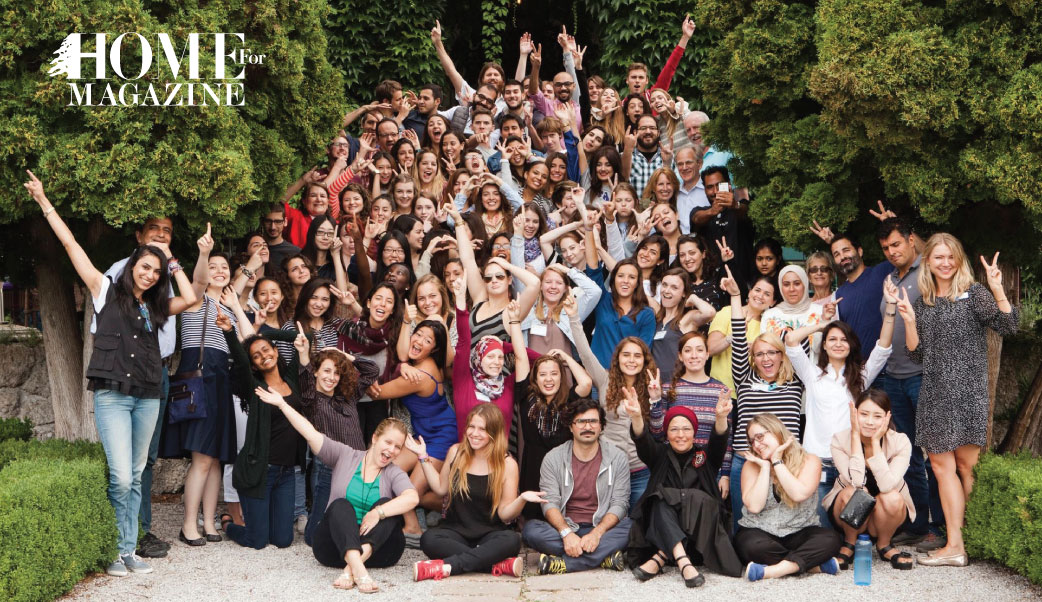
Salzburg Academy bring together students from different universities and helps in developing a network of people helping each other on multiple levels.
It’s a breath of fresh air, in every sense. Nestled on a lakeside just outside the old town, the Schloss Leopoldskron in Salzburg, is home to the Salzburg Global Seminar, which facilitates innovative and strategic engagement on issues of education, health, environment, and peace-building on an international level. Guarded not only by its wrought iron gates, but also by the Untersberg Mountain and the Hohensalzburg Fortress, the 18th century palace- like hotel also hosts the annual Salzburg Academy on Media and Global Change.
About the Academy
Every summer, the Academy brings together university students from all over the world, including the American University of Beirut (AUB) and the Lebanese American University (LAU). Around 70 to 75 students from every continent and a global body of professors gather to participate in a program that is rooted in media literacy education from a universal perspective. Various methods of teaching and learning that divert from more traditional ones are used: holding intense discussions, conducting hands-on assignments, workshops, cohesive group projects, developing case studies and unique media action plans, and learning through networking, arguing, critiquing, and debating, to name a few.
The overarching theme of the Academy changes each year, as the faculty attempts to branch out, expand, and explore ways to imagine, sustain, and attain justice for present and future generations. Previously, themes have included the environment, women’s rights, world views of marginalized communities, and many more. The Academy has also partnered with a number of prominent organizations including United Nations Development Programme, Red Cross, Red Crescent and Global Voices to shape and implement various projects.
2016 marks the 10th anniversary, and to celebrate its birthday, the Salzburg Academy will invite a number of alumni to participate in the program again, which this year focuses on cross-cultural dialogue about migration. Members and collaborators will talk about how the media shapes and influences stereotypes, as well as how young activists can use their shared public narratives to bridge social and cultural divides.
Dr. Jad Melki, associate professor of journalism and media studies at LAU and visiting faculty at the Salzburg Academy, said that the 10th anniversary is primarily valued by the faculty and alumni because students come and go every year, but the professors and expert lecturers have been relatively constant.
“It’s important for us to be able to look back over ten years and ask ourselves what we’ve done, what research and books we’ve produced on the topics discussed, and envision plans for the next ten years. The faculty members have become a very close-knit group of colleagues and friends. We have developed a strong network of people helping each other on multiple levels, both professionally and personally. It’s really more like a family than anything else,” says Melki. The program’s veterans look forward to seeing each other over the year at two conferences for the Salzburg Global Seminar, in addition to the summer Academy.
The sessions and activities
Students partake in sensitive and intimate discussions that allow them to realize how different they all are, but simultaneously how much they have in common. They embrace diversity and the myriad of backgrounds, histories, religions, heritages, and HOMEs from which they stem, all the while acknowledging how people from around the world perceive their surroundings and systems of belief.
This is done not only by the sequences of plenary sessions and conferences led by key speakers, journalists, and representatives from international organizations and NGOs, but also through the many side activities promoted and executed by the faculty.
These also change on an annual basis, but the ideas behind them are most deeply rooted in unity-seeking and frameworks of engagement. The weekly photo contest, the talent show, a piano concert, the Academy World Cup soccer game, film screenings, and various excursions to other parts of Austria push the Academy’s participants to persevere and break down the barriers perpetuating separation.
For instance, the Human Library took place last summer at the 2015 program, in which participants volunteered to stand as “books” with labeled titles about a stereotype they’d been subjected to, which other people could “check out” and “read”. Profound and meaningful dialogue ensued between acquaintances, which often led to a more fundamental friendship. This practice aimed to demonstrate that each person has a story to tell and that we are all interconnected.
Student’s feedback
Melki echoed some of the feedback that he has received from AUB and LAU students over the last decade about what the Salzburg Academy on Media and Global Change has meant for them. “It’s almost become a cliché quote to say that ‘it’s a life- changing experience, a mind altering one,’ but it is.
They always say things like ‘this experience expanded my horizons’ or ‘this made me think about digital media and technology in different ways’ or ‘this made me realize how expansive the world around me is and how many mindsets there actually are’ or ‘I can now put myself in someone else’s shoes and see things from a genuinely different perspective.’”
“I can now put myself in someone else’s shoes and see things from a genuinely different perspective”
“Imagine for a moment someone who has lived all their life in a small Lebanese community, with people belonging to the same religion, the same background, the same socioeconomic status, the same education level.
When they go to university, they interact, make new friends and spend time with people from different religions.
Now, imagine they go to this amazing, beautiful place and are debating very powerful and controversial matters with people from all over the world, interacting with someone from a completely different ethnicity; a lower income Argentinian, or anyone who had a vastly different upbringing and perspective on life and then living three weeks and having fun together. It’s not like they have a formal debate and then everyone goes home. No, they have to deal with each other every morning at breakfast, lunch and dinner, at the club, in the seminar room, in their groups,” says Melki.
The Salzburg Academy is a home away from HOME, where the connections people make within the walls of the Schloss withstand over the years and form a platform for hope.
RELATED ARTICLES


DID YOU KNOW THAT ONE OF BEST ARTISTS IN 2024 WAS A LEBANESE 20YRS OLD GUY?
HOME THEMES
DID YOU KNOW THAT ONE OF BEST ARTISTS IN 2024 WAS A LEBANESE 20YRS OLD GUY?
HOME EVENTS
DID YOU KNOW THAT ONE OF BEST ARTISTS IN 2024 WAS A LEBANESE 20YRS OLD GUY?
CULTURAL LIAISON
LET’S TALK

